How Peptides Work: A Beginner's Guide for Researchers
May 29, 2026
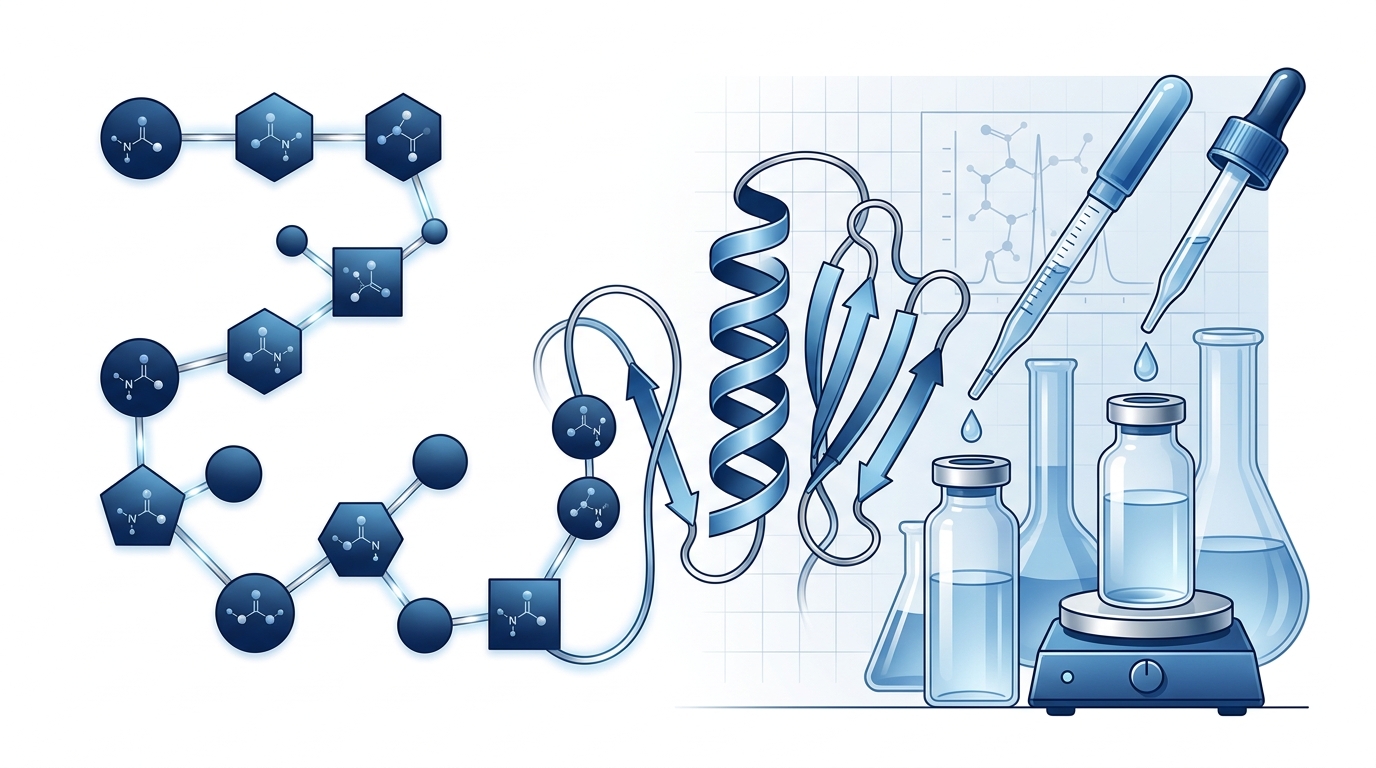
Peptides are short chains of amino acids that serve as critical tools in modern research laboratories. Understanding their fundamental mechanisms helps researchers select the right compounds for their studies and handle them properly.
What Are Peptides?
Peptides consist of 2-50 amino acids linked by peptide bonds. Anything larger becomes a protein. The sequence and composition of these amino acids determine each peptide's unique properties and research applications.
Three key structural features define peptides:
- Primary structure: The linear sequence of amino acids
- Secondary structure: Local folding patterns like alpha helices or beta sheets
- Tertiary structure: The overall 3D shape (more relevant for longer peptides)
These structures directly influence how peptides interact with cellular receptors and other molecules during research experiments.
The Mechanism of Action
Peptides work primarily through receptor binding. When a peptide encounters its target receptor on a cell surface, it triggers a cascade of intracellular events.
The binding process follows these steps:
- The peptide approaches the cell membrane
- Specific amino acid sequences recognize and bind to receptor sites
- Receptor conformational changes activate intracellular signaling pathways
- Secondary messengers amplify the signal throughout the cell
- Cellular responses occur (gene expression changes, enzyme activation, etc.)
Binding affinity varies dramatically between peptides. Growth hormone releasing peptides like GHRP-6 show nanomolar affinities for their receptors, while other research peptides may require micromolar concentrations to achieve similar receptor occupancy.
Types of Research Peptides
Signal Peptides These peptides transmit information between cells. Examples include neuropeptides that modulate neural activity in neuroscience research.
Carrier Peptides Designed to transport other molecules across cell membranes. Cell-penetrating peptides like TAT (derived from HIV-1) can deliver cargo molecules into cells for research purposes.
Enzyme Inhibitor Peptides Block specific enzyme activity. ACE inhibitor peptides are studied extensively in cardiovascular research models.
Antimicrobial Peptides Natural defense molecules studied for their ability to disrupt bacterial membranes. LL-37 and defensins represent well-characterized examples.
For research use only. Not for human consumption.
Peptide Stability and Storage
Peptide stability depends on multiple factors:
Temperature: Most lyophilized peptides remain stable at -20°C for 12-24 months. Once reconstituted, stability drops to days or weeks.
pH: Peptides generally show optimal stability between pH 5-7. Extreme pH values accelerate degradation through deamidation or hydrolysis.
Light exposure: UV radiation can oxidize tryptophan and methionine residues. Store peptides in amber vials or wrapped in foil.
Oxidation: Cysteine and methionine residues oxidize readily. Adding antioxidants or storing under inert gas extends peptide lifespan.
Reconstitution and Handling
Proper reconstitution ensures accurate research results. Start with the appropriate solvent:
- Basic peptides (high arginine/lysine content): Try 0.1% acetic acid
- Acidic peptides (high aspartate/glutamate): Use 0.1% ammonia solution
- Hydrophobic peptides: DMSO or DMF may be necessary
Calculating proper dilutions requires precision. Use our Peptide Calculator to determine exact reconstitution volumes and concentrations for your specific research needs.
Always use sterile techniques:
- Allow peptide vials to reach room temperature before opening
- Use sterile, filtered solvents
- Add solvent slowly down the vial wall
- Avoid vigorous mixing - gentle swirling prevents foam formation
- Aliquot immediately to minimize freeze-thaw cycles
Common Research Applications
Cell Culture Studies Peptides help researchers understand cellular signaling pathways. Concentrations typically range from 0.1 nM to 10 μM depending on the specific peptide and cell type.
Receptor Binding Assays Radiolabeled peptides enable precise measurement of receptor density and binding kinetics. Competition assays reveal receptor specificity and affinity constants.
In Vivo Research Models Animal studies use peptides to investigate physiological processes. Dosing varies widely - GLP-1 analogs might be administered at 10-100 μg/kg, while other peptides require mg/kg doses.
Biomarker Development Peptide-based assays detect specific proteins or cellular states. Mass spectrometry methods can quantify endogenous peptides at femtomolar concentrations.
Quality Considerations for Research
Peptide purity directly impacts research outcomes. Key quality parameters include:
- HPLC purity: Research-grade peptides should exceed 95% purity
- Mass spectrometry confirmation: Verifies correct molecular weight
- Endotoxin levels: Critical for cell culture work (< 1 EU/mg)
- Residual TFA content: Can affect cell viability and receptor binding
Peptide Depot provides detailed certificates of analysis for all research peptides, ensuring Canadian laboratories receive thoroughly characterized materials for their studies.
Troubleshooting Common Issues
Poor solubility: Try sequential solvents - start with water, then dilute acetic acid, then organic solvents. Sonication in a water bath can help.
Aggregation: Some peptides form fibrils or aggregates. Adding 10% DMSO or using fresh preparations minimizes this issue.
Loss of activity: Peptides can adsorb to plastic surfaces. Use low-binding tubes and include carrier proteins like BSA at 0.1% to prevent losses.
Inconsistent results: Verify peptide concentration using UV absorbance at 280 nm (if aromatic residues present) or colorimetric assays like BCA.
Moving Forward with Peptide Research
Success with peptides requires attention to their unique properties. Start with high-quality materials, handle them carefully, and maintain consistent protocols. Document storage conditions, reconstitution dates, and handling procedures.
For Canadian researchers seeking reliable peptide suppliers, consider factors like shipping temperature control, analytical documentation, and technical support availability. Proper sourcing combined with careful handling ensures reproducible results.
Remember: All peptides discussed are for laboratory research use only and not for human consumption.
Whether investigating novel signaling pathways or developing new analytical methods, understanding peptide fundamentals provides the foundation for successful research outcomes.